
The first prisoners of World War 2 (POWs), detained in Britain, were German aircrew or naval personnel, but their numbers were small and rather than being held in Britain they were generally sent to various parts of the British Empire. From July 1941 Italian POWs captured in the Middle East were brought to Britain. This was the first major influx of POWs to the country necessitating the construction of purpose-built prisoner of war (POW) camps. However, following the armistice between the Italian government and the Allied armed forces in September 1943, some 100,000 Italian POWs volunteered to work as ‘co-operators’. Italian co-operatives were housed in what were classed as ‘hostels’, allowing them to live outside a high-security detention camp.
German prisoners of war flooded into Britain from the summer of 1944 following the D-Day landings in France. They were housed in hundreds of camps all over the country. The peak number of German prisoners reached 402,200 in September 1946. Although there was an initial reluctance to employ them for labour, 70,000 were working in Britain by March 1945. The end of the war in Europe, in May 1945, did not trigger the release of POWs held in Britain; the last large group of German Prisoners Of War left Britain in November 1948.
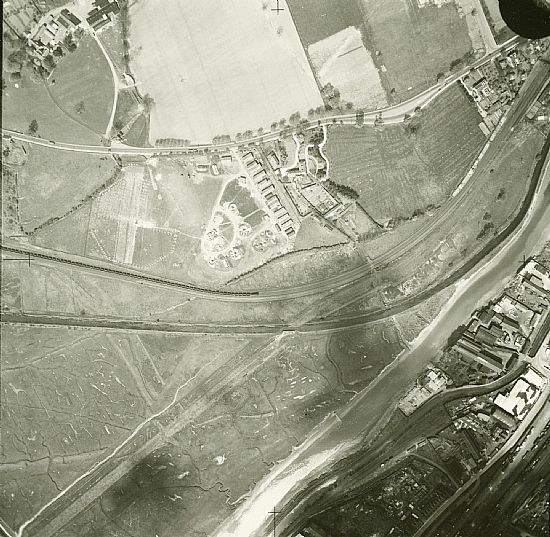
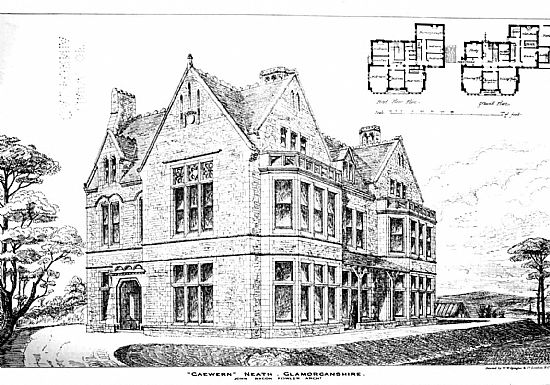
In February 1941 four guns of 246 Battery, 79 Heavy Anti-Aircraft Regiment RA (TA), were sited on the open land adjacent to the property known as Glynleiros, with additional gun sites at Llansamlet, Jersey Marine, Mumbles and Sketty. A Gun Operations Room (GOR) was set up in Swansea, but on the night of 19th February 1941 the building housing the GOR was destroyed by a direct hit during a heavy raid, resulting in the GOR being temporarily relocated to Neath.[1] At the start of 1942 the 79 HAA Regt was ordered to convert from a four-battery static organisation to a three-battery mobile unit in preparation for overseas service and so by June 1942 the Regiment was relieved of its duties at Neath. During this time the training regiments were turning out a regular stream of Mixed HAA batteries which Anti-Aircraft Command formed into regiments to take the place of the all-male units being sent to overseas theatres of war.[i] One such new Regiment was 186 (Mixed) Heavy Anti-Aircraft Regiment RA (TA) formed at Llangennech, Llanelli in December 1942. The Royal Artillery men crewed the guns and the Auxiliary Territorial Service (ATS) women handled all other aspects of control, including range finding, predictor, search lights, communication and all other roles, other than actually firing the guns.[ii] In June 1943 Neath extended a hearty welcome to the ATS girls that had come to stay in its vicinity.[iii] As well as billeting the girls with families it was necessary to construct a barracks for them and the site chosen for the huts was in Dwr-y-Felin Road.[iv] In the region of 20 huts were constructed with Regimental Headquarters based at Caewern House. In addition to the Neath Abbey gun site there were contingents of the Regiment at Mumbles, Jersey Marine and Margam.[v] The 186 (M) HAA RA Regt was disbanded at Neath in March 1945, but before this the Regiment suffered one fatality and witnessed a marriage - Gunner Robert Seville died as the result of a shooting accident and Gunner Leslie Stewart married Sylvia Miles. Caewern House, farm buildings, Lodge and land was let to the Price Brothers on 29th September 1944, which suggests that the military occupation of the house and ATS huts had been terminated before this date.[vi]
By the middle of 1946 German POWs were occupying the vacated barracks at the Neath Abbey Road gun site; Major FH Mann was commandant of Camp 284 Neath Abbey Road assisted by Lieutenant F Newbold with Lieutenant William Ross as adjutant. Staff Sargent Kessler was interpreter. Although not a purpose-built POW camp, by November 1946 the camp held 616 German POWs (no officer ranks) and was responsible for administration of five hostels housing German POWs.[vii] German POWs were subject to political screening by the Foreign Office Political Intelligence Department (PID) who graded the POWs as: A – Anti-Nazi or non-Nazi; B – Individuals with some Nazi sympathies or uncertain political leanings; C – Ardent Nazis or SS members. In December 1946 PID graded 37 POWs held at Neath Abbey Road as category C and these prisoners were segregated to isolate them from other prisoners; 334 prisoners remained unscreened at this time. The camp leader was Hauptfeldwebel [Company Sergeant Major] Gonscharek, aged 29, a professional soldier he had been given a political screening grade of B - the better the grade, the sooner the individual was repatriated. Morale at the camp was initially reported as poor, with the lack of news about repatriation and negative news from home being cited as the major factors. No German newspapers were provided and the library was very inadequate for the number of prisoners held at the camp. Films were only available for screening fortnightly, which led to apathy and boredom becoming a main concern for Major FH Mann. From the beginning of October a fortnightly camp magazine, Der Anker [The Anchor], was published but due to a paper shortage it was limited to 100 copies and in March 1947 it ceased publication.[viii] The situation was further compounded by the fact that the police refused to allow the POWs into Neath, except for organised visits – fraternization between the POWs and locals was strictly forbidden, but not always adhered too; the ban was lifted for Christmas 1946, when German POWs were allowed to visit British homes where they had developed friendships and relationships with locals.
A report at the end of 1946 recorded morale as being “fair.” Positive factors included improved recreational facilities, a wireless set (not powerful enough to receive any stations from Germany) was located in the Camp Leader’s office with an extension speaker in the dining hall. A choir and small orchestra had been formed and sporting activities had been introduced. The PID inspection report for 13th -16th May 1947 again recorded some improvements in morale which was mainly due to ‘excellent relationships between POWs and farmers, and POWs commented on extremely good treatment by British staff.’ There were no longer any C grade POWs held at the camp and 162 POWs had been repatriated to date. The narratives by people about the German POWs, held at Neath Abbey Road, working on farms and developing friendships are supported by contemporaneous newspaper reports.[2]
Anecdotal examples of friendships include:
Catherine Richards of Wern Ddu Farm, “My grandparents had a German paratrooper to their house every Sunday afternoon for tea. He had been captured in Crete. After the war he returned to East Germany where he worked as a postman. My grandparents kept in touch for years.”
Trevor Thomas of Tyn-yr-Heol Farm, “I don’t remember much, but what I do remember is that we had German POWs, from Neath Abbey Road, picking potatoes one September. My father spoke very highly of them.”
Geraint Jones of Skewen recalls the bond his father established with a German POW. “Our families exchanged holidays, we went to Germany one year and Werner and his family came back to Neath on alternate years.”
“Kenneth and Margaet Vickery lived in a small cottage, known as Field Cottage, and one of the German POWs, Hermann Felber, was allocated to the family, probably for work purposes. One of the few memories his family have of his time with the Vickerys was being given an egg in coffee! Eggs were rationed to one egg per person per week, so to give an egg to a POW reflects the close friendship that had developed. Apparently, coffee with an egg is a Swedish recipe to take the bitterness away.”[ix]
One Sunday in May 1947 twelve POWs at the Neath Abbey Road camp presented a revue entitled ‘The Cockatoo’ before an audience of more than 150 guests from the district; Sunday was chosen because the men were engaged in farm work on the other days of the week. Welcoming the guests Lieutenant Newbold stated that “this was the prisoners’ way to thank their friends in the district for their kindness and hospitality.”
By September 1947 only 118 POWs were being held and so Camp 284 Neath Abbey Road became a satellite camp to Camp 102 Llanddarog, Carmarthenshire, but it continued to administer its hostels; the PID report records the officer in charge as Capt. Coffman and that the camp had a six man orchestra and a theatre group. Later that year a choir of forty POWs took part in a singing festival at the Ebenezer Church in Neath Abbey (many of these men sent messages and Christmas greetings to members of the church in 1948). On 16th December 1947 Neath MP David J Williams questioned the Secretary of State for War as to when the Neath Abbey Road site, then housing POWs, would become available for housing purposes, Mr Emanuel Shinwel stated that he was not able to make a statement as to the future use of the site.[x] On 16th January 1948 Llanddarog camp became a hostel to Camp 70 Henllan Bridge, Llandyssul, Cardiganshire, but Camp 284 Neath Abbey Road was not included in the transfer, but at least one of its hostels was reassigned to Camp 118 Mardy, Abergavenny, suggesting that Camp 284 Neath Abbey Road had been closed.[xi]
Some German POWs opted to stay in Britain rather than be repatriated. Maximillian Schubert was one, marrying Gwenllian Davies, of Taillwyd in 1948. Friedrich Gruna was another POW who opted to remain in the Neath area. Gruna had lived at Ynysllynlladd in Cadoxton since 1947 working as a farm labourer, but in 1953 he stole jewellery for which he was imprisoned for six months.[xii]
After the last POW left Camp 284 Neath Abbey Road the site had multiple uses. The Ministry of Agriculture and Fisheries initially used the site to house agricultural workers; the ‘Hostel’ was managed by the Young Men’s Christian Association ensuring that the accommodation was affordable for the workers. At the same time a small part of the site was allocated for use by the Territorial Army. Major DB Norris, R.A. was the officer commanding the Neath Heavy Anti-Aircraft Battery of the 671 (M) HAA Regt, with Subaltern Prudence M Glover commanding the WRAC detachment. The site care taker, William Hales, with his wife and two daughters, occupied one hut.
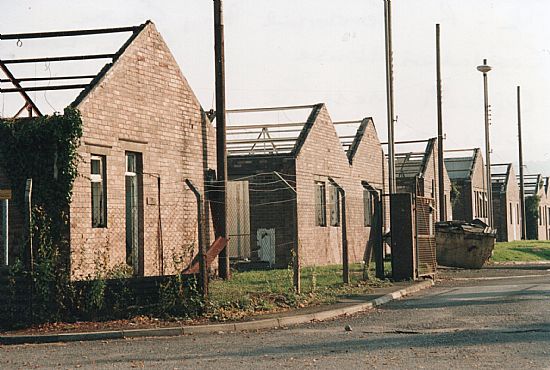
More recently businesses that have been based at the site of the barracks have included British Telecom Engineering and CSN Precision Engineering. Currently an Aldi store occupies a large part of the site that once was Camp 284.
[1] The GOR was in telephone contact with all subordinate gun sites, ammunitions depots and transport companies etc. The GORs themselves were rarely purpose built, more usually they were large country houses adapted for the purpose. This situation generally lasted until the end of the War, when a huge stand down and general demobilisation occurred.
[2] South Wales Daily Post - 11th Nov 1946, Herald of Wales - 3rd May 1947, Herald of Wales - 10th May 1947
[i] Mixed referred to the fact the Regiment/Battery comprised of male RA Gunners and female Auxiliary Territorial Service (ATS) personnel.
[ii] The information from the height and range finder was sent to the predictor. The predictor was an instrument that was used to calculate how far in front of an aircraft the gun would have to fire in order to explode close enough to the aircraft to knock it off course,
[iii] Neath Guardian- 11th June 1943 – ‘Home life for ATS’
[iv] Electoral Register, Neath Division, 1947 Dwr-y-Felin Road.
[v] 4th Glamorgan (Neath) Battalion Home Guard: Appendix M (page 24) Regular Units in Battalion Area: 186 Mixed HAA Regiment; HQ Caewern Neath; Tel. Neath 669.
[vi] NAS Z 1/3 - Neath Antiquarian Society
[vii] WW2 P.O.W. Camps in the UK – Camp 284 Neath Abbey Road - Malcom Sanders
[viii] The Wiener Holocaust Library: https://www.whlcollections.org/image/111228/
[ix] History on My Doorstep – Taillwyd, its houses and its people - Martyn Griffiths
[x] Hansard UK Parliament, 16th December 1947, Vol 445
[xi] WW2 P.O.W. Camps in the UK – Camp 102 Llanddarog, Carmarthenshire - Malcom Sanders
[xii] Neath Guardian – 24th July 1953 – ‘Betrayed Confidence of Good Employer’
