
NEWS & MEMBERS ARTICLES
07 October 2026A VICTORIAN POLICEMAN
A VICTORIAN POLICEMAN
MARTYN J GRIFFITHS
Coal, iron, tin and copper, all industries which drew workers to South Wales. As well as these, thousands more arrived in order to service the rapidly expanding population. Grocers, drapers, carpenters and all sorts of other trades. To control this often lawless mass of people the new Police Forces needed to recruit and many of the new ‘bobbies’ were obtained from distant parts of England and even Scotland.
Superintendent John Howlett is buried near the entrance to St. Matthew’s church, Duffryn, but he started life right across the other side of the country at Beccles in Suffolk. His father was sometimes listed as a carpenter and sometimes as an agricultural labourer. Life was hard working on the land and wages were low. John had followed his father as an ‘ag. lab.’ but he had ideas to better himself and when the call came for recruits to a police force in far off South Wales he answered and was swiftly deployed to the hotspot of Merthyr Tydfil.
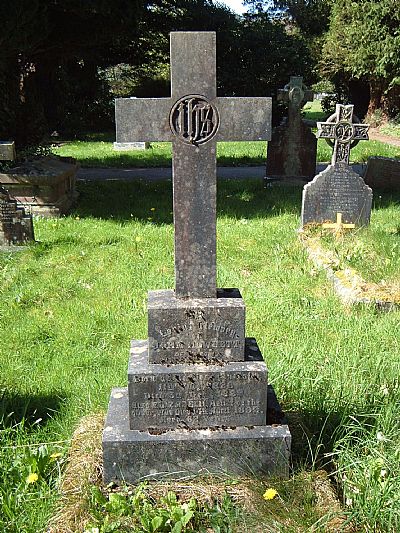
The Howlett grave at St. Matthw’s Church, Dyffryn
Recruits of the day ranged from 22 to 35 years of age and the take home pay for a constable, working seven days a week, varied between 15 shillings and 21 shillings per week. Each day involved 10 to 12 hours work, usually in split shifts; the longer shift being up to seven hours at night. Basic uniform was the same for all ranks and differed only in quality. The early Victorian constable wore a swallow-tail coat of dark blue cloth with well glazed stove-pipe hat and white duck trousers for summer use or blue serge in winter. The top hats and white trousers disappeared in the 1850s and 60s when helmets were brought in. In addition, the recruit was issued with an oilskin cape, staff, handcuffs, rattle, button brush and an instruction booklet. Cutlasses were issued for night patrol. Uniform was worn at all times and either a deposit was charged for the uniform or 5 shillings deducted from the constable’s wages on leaving the force. Rest days were rare and one day off in four or six weeks was normal. If an officer was absent through illness, his pay was reduced or stopped and annual leave consisted of one week a year, without pay.
Former Metropolitan policemen and burly farmers were very welcome in the troublesome industrial town of Merthyr. The villains of Merthyr were legends in their time and much has been written about the rogues of Chinatown. It is some reflection of the problems policing Merthyr that, when the Glamorgan Police Force was formed in 1841, twelve of its original thirty four officers were posted to Merthyr.
Some of those who joined the new Welsh Police Force transferred from the Metropolitan Police or from other fledgling constabularies, but there is no evidence that John Howlett had that sort of background. He was posted to Merthyr in 1852 or perhaps a few months earlier and he soon made a name for himself. By 1856 he was a sergeant and put in charge of the Market Street Police Station. Ten years later he was promoted to Inspector.
THE FENIANS
Dozens of cases brought by Howlett are available to read in the Quarter Sessions records at Cardiff archives, but the most famous case in which he was heavily involved is not there.
The Fenian Brotherhood was established in America in 1858 and it was nine years later that there was a rising in Ireland which found a branch of its cause in the hills around Merthyr. Their ultimate aim was an independent Ireland. Howlett seems to have been a very active police officer and, as part of his duties, for months he kept an eye on the comings and goings of a pub called the ‘Exile of Erin’. One night in early December 1867 he was crossing the mountain on the Rhymney side when, by the light of the blast furnaces, he saw a crowd of men who rapidly dispersed on seeing him. He managed to collar a few and based on information gained, observations of the Irish community intensified. The Irish were using these night-time mountain gatherings to drill and to prepare for armed conflict.
On Christmas Day a suspected Fenian named Coffey was arrested. Information received from him and other sources led to a series of raids by officers armed with cutlasses and pistols.
“It was a bitter night and how one hailed the urbanity of Inspector Howlett, and the warm and sanded mess room at the station. When we arrived, the room was tolerably full of policemen, and they looked business-like unmistakably, with swords lying in all directions, and a few beautifully got up ‘six shooters’, ugly enough to make any Fenian shudder.”
The Chief Constable Colonel Lindsay, Divisional Commander Superintendent Wren and Inspector Howlett led these raids and in total eleven men were arrested.
The arrested men were incarcerated in the gaol at Cardiff and taken by train for the committal proceedings in Merthyr. A special carriage was provided and the train, as well as every railway station en-route, the road to the court-house and indeed, the court room itself, were flooded with armed police officers and special constables brought in for the occasion.
The trial took place in April 1868 in Swansea at the Glamorgan Spring Assize Court. Inspector Howlett stayed at the Cambrian Hotel whilst waiting to give evidence. Whilst there three Irishmen entered the premises believing that the informant Coffey was staying there. They were all drunk and causing damage in the bar, so the help of the Inspector was sought. With difficulty, he managed to eject all three but outside the three of them attacked Howlett, one of them armed with a stick and it was only after a prolonged fight that he succeeded in subduing them and not without damage both to his clothes and his person. At their subsequent court hearing they each were sentenced to two months hard labour as well as having to pay for the damage caused.
At the Fenian trial, doubts surrounding the credibility of the evidence of the informant led to eight of the ten defendants being acquitted. Patrick Doran, the head of the organisation, was sentenced to sevenyears penal servitude and his subordinate, Patrick Ryan, one of the captains, to three years.
A MOVE TO NEATH
Following a few years as Inspector in charge at Aberdare, he was elevated to the rank of Superintendent in charge of the Swansea Division of the Glamorgan Constabulary in August 1870. This was a huge area stretching from the Loughor estuary and included Aberavon and Cwmgwrach. Originally the base for the Swansea Division was meant to be Pontardawe, but this was amended to Neath as there were plans for a combined Neath Borough and Neath County Police Station. The county police in Swansea seem to have been based at Sketty, from where they could show the flag by making occasional journeys into the Gower peninsular. They do not seem to have had a station inside Swansea Borough (as in Neath Borough) although there exists a turn of the century photograph of the county police parading outside the Guildhall, which is today the Dylan Thomas Centre.
The Superintendent’s job today is one mostly of administration but in Victorian Britain it meant also being hands-on. Even the redoubtable Superintndent Wrenn of Merthyr once gave evidence sporting a black eye given to him whilst arresting a man for assault.
The Howletts lived in Green Street in 1871, but a year later moved to The Ropewalk. They had no children of their own but virtually adopted a niece, the daughter of Inspector William Hodgson of Pontardawe.
The town of Neath was a bustling place with 57 taverns serving its population. The small Borough Police Force consisted of a Superintendent - John Phillips - one sergeant and six constables and there was a frequent turnover of manpower due to drunkenness and "multiplicity of duties". Neath was a busy port as well as an industrial centre and the town itself had recently expanded south with new roads being constructed at Queen Street and Windsor Road.
The County Police Station was originally adjoining the Borough Police Station in James Street, next to the gaol. The building was purpose built in 1807, but they had terrible problems with drainage from the local slaughterhouse and there was much illness in the area.
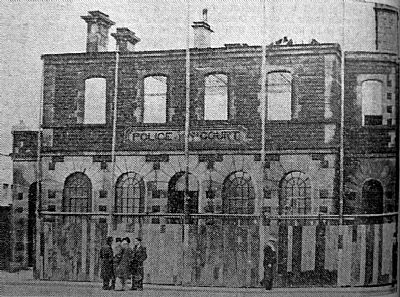
The new County Police Station under construction in 1862.
It opened the following year. It was replaced in May 1937.
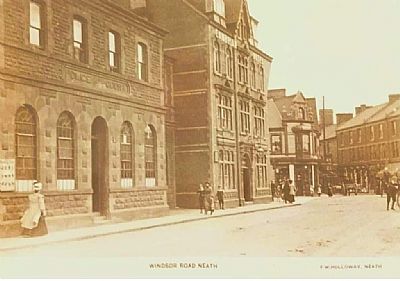
Police Station on the left flanked by the Cambrian Hotel
John Howlett died in December 1889 whilst still serving and a grant was made by the Force to his widow. Howlett was shown at this time as living at 3 Neath Abbey Road, Neath, (Millbrook Villa) and in his will left nearly £3,000 to his widow. The wills index shows that he was staying at the Midland Hotel, Morriston when he died and this suggests that his death came quite unexpectedly.
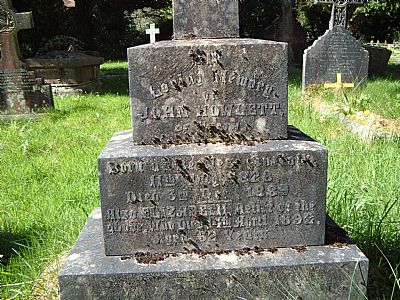
John Howlett’s grave at St. Matthew’s church, Dyffryn, Neath
The Cambrian newspaper reported his death thus:
‘In the person of Mr. Howlett, Superintendent of the County Police for the Swansea Division of Glamorgan, death has removed from our midst, with startling suddenness, another old and well-known and faithful public servant. So recently as on Saturday last he was present at the Swansea County Petty Sessions in pursuance of his duties. He was then hale and hearty, to all appearances, and did not complain, but it had been noticed for some time that he had developed an odd tendency to sudden somnolency even when in attendance in court. On Monday he drove from Morriston to Clydach through the cold east wind. The result was a sudden seizure of an apoplectic kind, coupled with paralysis and total loss of consciousness. Dr. Gabe was called in, and at 2 o'clock on Tuesday morning, Dr. Padley, our most experienced and respected Swansea physician, was roused out of bed. and went off at once to the sick man's bedside for consultation. But there the sufferer lay, a Hercules in physical stature, in fine condition of body, but wholly unconscious from effusion of blood upon brain and consequent total paralysis. Everything that medical and surgical still could suggest was tried, but without avail, and death supervened on Tuesday evening at 8 o'clock.
Superintendent Howlett had been a great many years in the County Force, and was generally respected as a genial man and vigilant officer. As Inspector of Weights and Measures he had enjoyed, it is said, considerable emoluments, which however had been lessened by recent Local Government changes and alteration of district. He had been for some time conscious of a dangerous tendency of his blood to rush to his head, and, no doubt, recent county changes did not contribute to such equanimity as such tendencies counsel on the parry of sufferers. These worries, coupled with the sudden and most severe alterations of climactic conditions in the first part of the week, were too much for his otherwise strong constitution.’
17 August 2026Just A Housekeeper?
JUST A HOUSEKEEPER?
MARTYN J GRIFFITHS
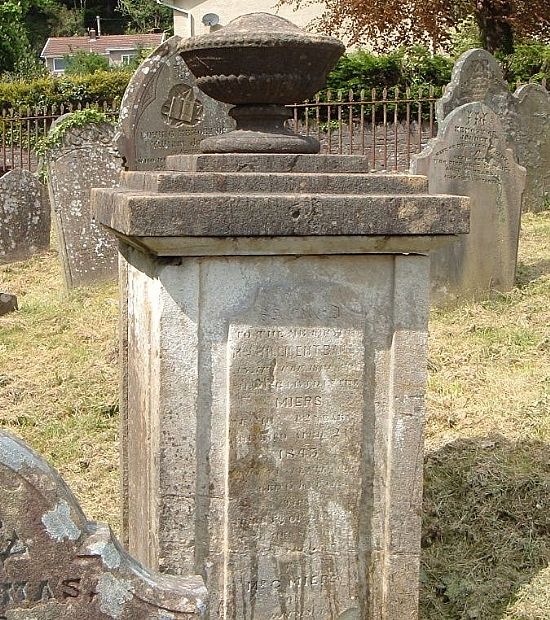
Standing to the front of St. Catwg’s church, between the entrance and the car park, is a substantial pillar type gravestone with a crumbling and almost indecipherable inscription. What draws one’s attention to it is the name MIERS.
The Miers family were industrialists who came to the Neath area in about 1736, eventually settling at Cadoxton Lodge where they stayed until it was sold to George Tennant in 1823. In Cadoxton they had interests in the Ynysygerwen Tinplate Works and perhaps the best-known family member was Molly (Mary) who married the last of the Mackworth family of the Gnoll Estate and then, after his premature death, Capel Hanbury Leigh of Pontypool Park. She owned Neath Castle and the land on which the Friends Meeting House was built.
The gravestone was erected by Capel Miers and it is a memorial, not to a family member, but to a housekeeper, Millicent Mildred Bailey.
She had most likely been housekeeper at Ynysygerwn and was still with the family in 1841 at Ynyspenllwch, which house was later converted into a convent and is today Manor Park in Clydach. She must have been very important to the family to merit such a grand memorial.
The housekeeper was, with the butler, one of the most senior members of the household. She ruled the roost over the female members of staff and was in charge of household accounts. Her role was relatively well-paid, she had her own rooms and there were other benefits such as tips from guests and free food which meant that most of her income could be saved. The wages varied, depending on the size of the mansion and the wealth of the employer but typically would have been about 16 guineas a year.
Very little is known about Millicent Bailey. She was 61 years of age when she died and was buried 29th April 1843, but where she was born remains a mystery. At the time of her death she was living in Ynyspenllwch.
Apart from the grand design of her memorial, her will (PROB 11/1980/254) also leaves many questions. She made her will in 1828 and at that time was living in Bridgend. For a lady of seemingly limited income, she left bequests to more than twenty people including the housekeepers for Capel Hanbury Leigh, Anthony Hills (Merthyr Plymouth Works) and John Miers. The only family member named is a step-mother living in Uttoxeter, Staffordshire.
A few years after her death Capel Miers (then of Drymma) was sorting out the will of his late brother, John Nathaniel Miers and that included a debt of £2,270 owing to his housekeeper Millicent Bailey. (NLW. Ref. GB 210 40) That is today’s equivalent of about £240,000. She didn’t save that on 16 guineas a year!!
There is one more clue as to Millicent’s origins. When she made her will, the solicitor she engaged was Henry Mostyn of Usk. Were there family links in that area? Perhaps her wealth came from the Bailey family who owned the Nantyglo ironworks.
Perhaps we will never know for certain. The grave remains a mystery for now.
