
NEWS & MEMBERS ARTICLES
24 November 2026Rhyddings Estate
THE RHYDDINGS
Martyn J Griffiths
At the start of the nineteenth century the Neath and Dulais valleys were dominated by landed estates. Briton Ferry, Gnoll, Neath Abbey, Ynysygerwn, Rheola, Aberpergwm; there were lots of estates both small and large, one of the smallest of these being the Rhyddings Estate. Very little has been written about the Rhyddings and there are plenty of mysteries surrounding this estate. How did it get it name? How large was the estate? Who were the owners and occupiers?
THE NAME
There has been a lot of conjecture over the name. Over the years it has been referred to as Redding, Reeding (most popular), Rheeding, Rhedin, Rhydin, Rhyddin and, its most modern form, Rhyddings. The meaning is equally obscure.
One writer stated that in Middle English rid or ridding meant to clear a space, especially of trees. In Welsh, Rhydd means free (unencumbered). The author added that the Norman word for such an area was 'assart' (as in Cwrt Sart, Briton Ferry), so he believed that the name Rhyddings had its origin before the Normans arrived. Another suggestion is that it is derived from the Welsh for ferns, rhedyn.
The name Rhyddings occurs in Swansea, Oswaldtwistle (Lancs), in Leeds as the name of a kennels! and a village near Bradford is called Ben Rhydding and is believed to have acquired its name from the ancient term for the uplands of that area. There is also a Rheedings farm in Sussex.
The north of England was dominated at one time by the Danes which might suggest another meaning. ‘Riding’ is a Norse name - originally ‘thriding’ – meaning a third part. Maybe the Rhyddings near Neath was originally a third part of the original estate based at Cilybebyll.
THE OWNERS
THE PENRY FAMILY
The earliest known owners of the land today called the Rhyddings, was a family who claimed descent from Iestyn ap Gwrgan, the last king of Glamorgan. One of his sons, Rhys, inherited a tract of land referred to as Rossaulin or Soflen or as the area is known today, Resolven. This he exchanged for land controlled by Neath Abbey at Cilybebyll. How extensive this land was we do not know; it may perhaps have included the Rhyddings.
The early genealogy and ownership was: Iestyn ap Gwrgan – Rhys – Iorwerth – Morgan Gam (died 1241) – Morgan Vychan (died 1288) – Rhys – Evan – Gwilym.
It is here, eight generations removed from Iestyn ap Gwrgan, that the genealogy at last names Gwilym’s son as Llewelyn of Rhydin. It is the first mention of the name. Dates are hard to come by. We know that Morgan Vychan was Lord of Afan Wallia (also known as Nedd Afan) and died in 1288. Rhys, a younger son, inherited his father’s lands in Baglan and was the ancestor of the Mackworth family of the Gnoll and the Williams family of Aberpergwm.
Tracing the family from Llewelyn ap Gwilym the genealogy helpfully names the wives of the holders of Rhyddings Estate. They came from near and far (Baglan, Senghenydd, Ynysarwed, Abercunrig, etc…) but are consistently from gentry stock.
Llewelyn ap Gwilym – John – Howel of Reeding – Henry of Reeding - John of Reeding – Jenkin John Penry of Reeding.
John was the third son of Llewelyn ap Gwilym so maybe this is the time when the estate is divided and the area of Rhyddings as we know it today is passed on to this junior line of descent.
Again, we are scratching round to find some dates to put these names in context. John of Reeding leased a forge in Llangatwg in 1566, so we are now well into Elizabethan times. It is his son who adopts the English custom of a surname and his name is found in an Elizabethan document of 1598. The lineage continues for a few more generations:
William Penry of Reeding – Henry Penry
William Penry married Elizabeth, a daughter of William Price of Briton Ferry, whose other daughter Jane married a son of Sir Thomas Mansell of Margam. Henry, unlike his father, is not recorded as ‘of Reeding’ and he was the last male heir, his only son dying young. Again, to give a rough date to these events, William Price of Briton Ferry died in 1627.
THE SEYS FAMILY
At this time, i.e., 1627, Richard Seys is listed as a free tenant of Afan Wallia and is called upon to repair the sea walls at Baglan. The Seys family were from Boverton in the Vale of Glamorgan where amongst their number were several Attorney-Generals and High Sheriffs. The family were industrialists and Richard junior, like his father, worked coal pits and mines in the Tawe valley by grant from Sir Thomas Mansell. Richard senior had links to the area through his marriage to Mary Evans of the Gnoll (about 1594). In 1666 Richard junior was recorded in The Pembroke Survey of Neath Manor as holding land called ‘Tyrsegir Ycha’, later referred to as Tir Segur. Seven years later Blome’s Britannia lists amongst the nobility and gentry, ‘Richard Seys of Cadoxton, near Neath.’
Richard junior had married Catherine, daughter of the powerful Walter Thomas of Danygraig, Swansea. Her father held the town for the King during the Civil War and suffered the consequences thereafter. Before marrying Richard she had been married to Evan John Evans of Eaglesbush.
Richard’s son, William, succeeded him at 'Rhydin' and was himself High Sherriff in 1692. In his marriage settlement dated 1678 he is styled ‘son and heir’ of Richard Seys of Reeding but by the time he made his will in 1715 he is ‘of Swansea’. He died about ten years later. He retained coal mines in Baglan which he bequeathed to his own son, Evan, but it seems that the Rhyddings was no longer part of his estate.
There was no mansion on the Rhyddings Estate so the owners lived elsewhere. There is evidence too that they let or sublet the various properties on the estate. For example, William Broadber, a Neath alderman and ironmonger, held the lease of ‘Rheeding and Elyros’ from the Seys family after 1701 (GRO DF/D/2857).
Likewise, Benjamin French (the man who started the Mumbles passenger railway) held from Lord Vernon the lease of Rhyddings farm and mill from 1801 for three lives (WGAS D/D T 299/1-2). This was later renewed and continued in the family after his death until 1879 when the lease was surrendered (WGAS D/DT 345).
THOMAS FAMILY OF DANYGRAIG
Catherine Seys’ brother, William Thomas of Danygraig, gained control of the Rhyddings estate. He married Catherine, a daughter of Bussy Mansel of Briton Ferry. William had two sons who both died without heirs and the younger (another William) gave his estate to his uncle, Bussy Mansell. Thereafter the Rhyddings, along with the rest of the Briton Ferry Estate, passed to Lord Vernon and then to the Earls of Jersey.
THE TENNANT ESTATE
In about 1814/6 the Rhyddings Estate was purchased by George Tennant who was in the process of moving to Cadoxton from London. The estate was finally sold in 1951 and Leiros Park housing estate developed soon after.
THE ESTATE
The size of all estates fluctuate with the years, land being bought and sold by succeeding owners. The Rhyddings Estate included the farms called Rhyddings, Leiros, Gilfach, Cenfaes and Blaenhonddan.
Perhaps one of the best gauges of the size of the Rhyddings Estate in the mid-19th century is the Tithe Map where the area encompassed by the above farms totalled about 700 acres. Half of this acreage comprised Rhyddings and Leiros farms which were held by Benjamin French. Rhyddings farmhouse stood behind what is now Alexander Crescent and went out of use in the 1960s. The farm stretched from Llygad yr Haul in Caewern upwards as far as Gilfach Fach farm, near the western entrance to Bryncoch. It included much of what is now Bryncoch and was bounded largely to the south by the road to Pontardawe although Rheeding Mill and Pond (Mill Road today) were also part of the estate; and to the north by Cwmbach road. Three public houses were included; the Bottle & Glass, the Plough & Harrow and the Travellers’ Rest.
Benjamin French first leased the farm in 1801 and a few years later he advertised the mill to let. It was described as being situated on a plentiful supply of water and ‘equipped with the Pair of Stones (one pair French) and the Water Wheel 25 feet diameter’. The mill had obviously been recently rebuilt as it was said to be ‘quite new’ with excellent lofts for storing corn. There were four acres of land that went with the mill.
'The History of the Vale of Neath' was published in 1925 and the author, D Rhys Phillips, wrote that the mill 'was lately dismantled by Mr. EC Curtis, town clerk of Neath.'
COAL AND THE RHYDDINGS CANAL
Coal was the key to the estate ownership; at least in the seventeenth to nineteenth centuries. Keith Tucker gives some evidence of the English entrepreneur, Chauncey Townsend (1708-1770) being one of the first to exploit coal in the area.
A mineral lease (NAS Xl 2/3/1) dated 2nd January 1696/7 leased the coal under the Rhyddings to Henry Bowen of Cadoxton. The Lord of the Manor at this time was Bussy Mansel of Briton Ferry and the small estate was held by William Seys 'of Swanzey'. The same lease relates to an earlier document granted 8th October 1661. (The document actually refers to the 13th year of the reign of King Charles but he dated his accession from the death of his father and not from The Restoration). This was a lease, letting the property to William’s father, Richard Seys of Eaglesbush stating that it was, 'Known by the name of Rhooding and Elyros, in the former tenure or occupation of one John Griffith, gent.' Including in the property was a working grist mill 'in the tenure or occupation of Leyson Price, gent.'
When evidence was given to the House of Commons Committee on the Petition of Owners of Collieries in South Wales in 1810, the Rhyddings colliery was mentioned:
The colliery upon the Abbey Estate, about 43 years ago, it was then worked by means of a level which emptied itself into the River Neath, near the Chapel, above the Bridge…. Between a dog-kennel and a place called the Reddings….. Coals from the pits were conveyed to the side of the River for exportation, upon what was then called waggon-ways.
The map of Thomas Hornor dated 1818 depicts a tramway running from Cadoxton to the river bridge. This is probably not the same structure as mentioned above as that is said to have been on Neath Abbey Estate lands and the Commons reporter said that it was run by Thomas Williams (of Court Herbert), then by his nephew of the same name and later by Richard Parsons. The colliery was drained by means of a steam engine and a water-wheel and taken away by a leat.
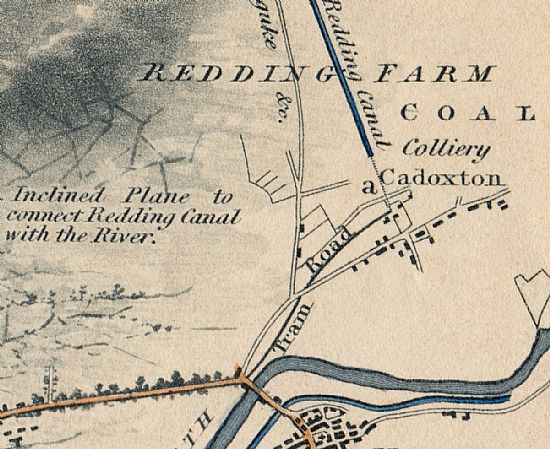
Thomas Hornor’s map of the area 1818 showing the Rhyddings Canal and Incline NAS EJ 7/1
There is no evidence of the Rhyddings Estate ever being owned by the Neath Abbey Estate, but that does not mean that the Rhyddings colliery did not have alternative ownership. That leads to the question, ‘Where was Rhyddings colliery?” On the map there is a colliery shown in Cadoxton but that is at the wrong end of the canal.
The ‘Reeding Canal’ today can be traced from Rhyddings farm as far west as the Gilfach road.
The eighteenth century colliery, said to be near the Duffryn Arms public house, was re-opened by George Tennant. He widened and extended the original leat and used wooden tub boats to transport the coal to Rhyddings farm. There the coal was transferred to an incline tramway which took the produce to the point on the River Neath already mentioned. Tennant upset Lewis Weston Dillwyn of the Ynysygerwn Estate in creating this tramway as he did not have permission to cross his land. As a result of this the tramway was diverted to pass under the turnpike road and past Cadoxton church to a wharf on the Tennant canal.
There are many old mine workings in the Rhyddings area and 'Rhyddings colliery' may have been a generic term, much in the same vein as Main colliery was in later years in the Skewen and Bryncoch area.
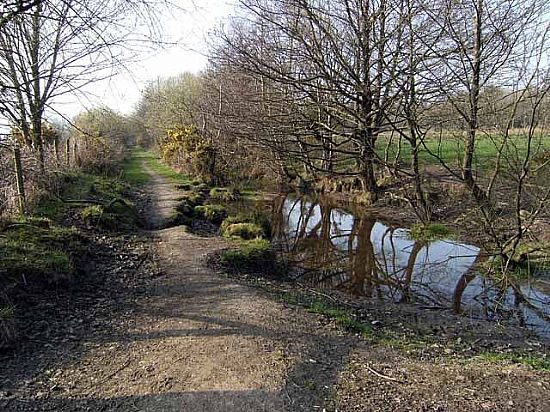 The Rhyddings Canal today Photo: Robert Davies
SOURCES
Chronicle of Cadoxton - Keith Tucker (1994)
Right of the Rhyddings by 'Gerontius' - Transactions, Neath Antiquarian Society (1977)
A Barrister’s Evidence by PR Reynolds - Transactions, Neath Antiquarian Society (1979)
Neath and Tennant Canals Trust – Quarterly Newsletter No. 128 (June 2009)
Abandoned and Vanished Canals of Ireland, Scotland and Wales - Andy Wood (2015)
The History of the Vale of Neath - D Rhys Phillips (1925)
A Scratch in Glamorganshire - Keith Tucker (1998)
History and Antiquities of Glamorganshire and its Families - Thomas Nicholas (1874)
With thanks to Ceri Creffield regarding possible interpretations of the name Rhyddings.
07 October 2026A VICTORIAN POLICEMAN
A VICTORIAN POLICEMAN
MARTYN J GRIFFITHS
Coal, iron, tin and copper, all industries which drew workers to South Wales. As well as these, thousands more arrived in order to service the rapidly expanding population. Grocers, drapers, carpenters and all sorts of other trades. To control this often lawless mass of people the new Police Forces needed to recruit and many of the new ‘bobbies’ were obtained from distant parts of England and even Scotland.
Superintendent John Howlett is buried near the entrance to St. Matthew’s church, Duffryn, but he started life right across the other side of the country at Beccles in Suffolk. His father was sometimes listed as a carpenter and sometimes as an agricultural labourer. Life was hard working on the land and wages were low. John had followed his father as an ‘ag. lab.’ but he had ideas to better himself and when the call came for recruits to a police force in far off South Wales he answered and was swiftly deployed to the hotspot of Merthyr Tydfil.
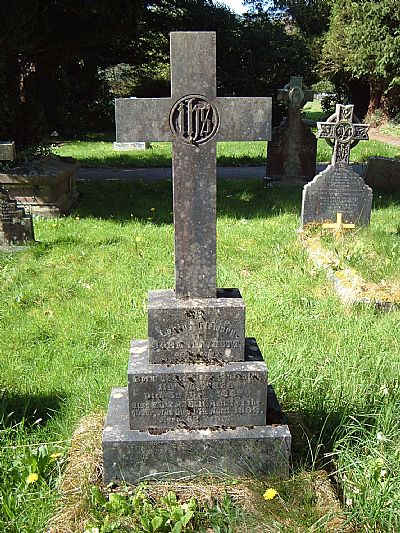
The Howlett grave at St. Matthw’s Church, Dyffryn
Recruits of the day ranged from 22 to 35 years of age and the take home pay for a constable, working seven days a week, varied between 15 shillings and 21 shillings per week. Each day involved 10 to 12 hours work, usually in split shifts; the longer shift being up to seven hours at night. Basic uniform was the same for all ranks and differed only in quality. The early Victorian constable wore a swallow-tail coat of dark blue cloth with well glazed stove-pipe hat and white duck trousers for summer use or blue serge in winter. The top hats and white trousers disappeared in the 1850s and 60s when helmets were brought in. In addition, the recruit was issued with an oilskin cape, staff, handcuffs, rattle, button brush and an instruction booklet. Cutlasses were issued for night patrol. Uniform was worn at all times and either a deposit was charged for the uniform or 5 shillings deducted from the constable’s wages on leaving the force. Rest days were rare and one day off in four or six weeks was normal. If an officer was absent through illness, his pay was reduced or stopped and annual leave consisted of one week a year, without pay.
Former Metropolitan policemen and burly farmers were very welcome in the troublesome industrial town of Merthyr. The villains of Merthyr were legends in their time and much has been written about the rogues of Chinatown. It is some reflection of the problems policing Merthyr that, when the Glamorgan Police Force was formed in 1841, twelve of its original thirty four officers were posted to Merthyr.
Some of those who joined the new Welsh Police Force transferred from the Metropolitan Police or from other fledgling constabularies, but there is no evidence that John Howlett had that sort of background. He was posted to Merthyr in 1852 or perhaps a few months earlier and he soon made a name for himself. By 1856 he was a sergeant and put in charge of the Market Street Police Station. Ten years later he was promoted to Inspector.
THE FENIANS
Dozens of cases brought by Howlett are available to read in the Quarter Sessions records at Cardiff archives, but the most famous case in which he was heavily involved is not there.
The Fenian Brotherhood was established in America in 1858 and it was nine years later that there was a rising in Ireland which found a branch of its cause in the hills around Merthyr. Their ultimate aim was an independent Ireland. Howlett seems to have been a very active police officer and, as part of his duties, for months he kept an eye on the comings and goings of a pub called the ‘Exile of Erin’. One night in early December 1867 he was crossing the mountain on the Rhymney side when, by the light of the blast furnaces, he saw a crowd of men who rapidly dispersed on seeing him. He managed to collar a few and based on information gained, observations of the Irish community intensified. The Irish were using these night-time mountain gatherings to drill and to prepare for armed conflict.
On Christmas Day a suspected Fenian named Coffey was arrested. Information received from him and other sources led to a series of raids by officers armed with cutlasses and pistols.
“It was a bitter night and how one hailed the urbanity of Inspector Howlett, and the warm and sanded mess room at the station. When we arrived, the room was tolerably full of policemen, and they looked business-like unmistakably, with swords lying in all directions, and a few beautifully got up ‘six shooters’, ugly enough to make any Fenian shudder.”
The Chief Constable Colonel Lindsay, Divisional Commander Superintendent Wren and Inspector Howlett led these raids and in total eleven men were arrested.
The arrested men were incarcerated in the gaol at Cardiff and taken by train for the committal proceedings in Merthyr. A special carriage was provided and the train, as well as every railway station en-route, the road to the court-house and indeed, the court room itself, were flooded with armed police officers and special constables brought in for the occasion.
The trial took place in April 1868 in Swansea at the Glamorgan Spring Assize Court. Inspector Howlett stayed at the Cambrian Hotel whilst waiting to give evidence. Whilst there three Irishmen entered the premises believing that the informant Coffey was staying there. They were all drunk and causing damage in the bar, so the help of the Inspector was sought. With difficulty, he managed to eject all three but outside the three of them attacked Howlett, one of them armed with a stick and it was only after a prolonged fight that he succeeded in subduing them and not without damage both to his clothes and his person. At their subsequent court hearing they each were sentenced to two months hard labour as well as having to pay for the damage caused.
At the Fenian trial, doubts surrounding the credibility of the evidence of the informant led to eight of the ten defendants being acquitted. Patrick Doran, the head of the organisation, was sentenced to sevenyears penal servitude and his subordinate, Patrick Ryan, one of the captains, to three years.
A MOVE TO NEATH
Following a few years as Inspector in charge at Aberdare, he was elevated to the rank of Superintendent in charge of the Swansea Division of the Glamorgan Constabulary in August 1870. This was a huge area stretching from the Loughor estuary and included Aberavon and Cwmgwrach. Originally the base for the Swansea Division was meant to be Pontardawe, but this was amended to Neath as there were plans for a combined Neath Borough and Neath County Police Station. The county police in Swansea seem to have been based at Sketty, from where they could show the flag by making occasional journeys into the Gower peninsular. They do not seem to have had a station inside Swansea Borough (as in Neath Borough) although there exists a turn of the century photograph of the county police parading outside the Guildhall, which is today the Dylan Thomas Centre.
The Superintendent’s job today is one mostly of administration but in Victorian Britain it meant also being hands-on. Even the redoubtable Superintndent Wrenn of Merthyr once gave evidence sporting a black eye given to him whilst arresting a man for assault.
The Howletts lived in Green Street in 1871, but a year later moved to The Ropewalk. They had no children of their own but virtually adopted a niece, the daughter of Inspector William Hodgson of Pontardawe.
The town of Neath was a bustling place with 57 taverns serving its population. The small Borough Police Force consisted of a Superintendent - John Phillips - one sergeant and six constables and there was a frequent turnover of manpower due to drunkenness and "multiplicity of duties". Neath was a busy port as well as an industrial centre and the town itself had recently expanded south with new roads being constructed at Queen Street and Windsor Road.
The County Police Station was originally adjoining the Borough Police Station in James Street, next to the gaol. The building was purpose built in 1807, but they had terrible problems with drainage from the local slaughterhouse and there was much illness in the area.
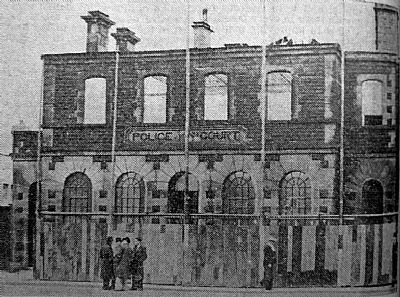
The new County Police Station under construction in 1862.
It opened the following year. It was replaced in May 1937.
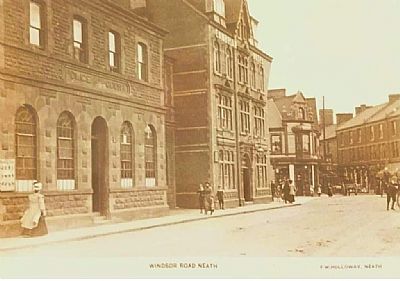
Police Station on the left flanked by the Cambrian Hotel
John Howlett died in December 1889 whilst still serving and a grant was made by the Force to his widow. Howlett was shown at this time as living at 3 Neath Abbey Road, Neath, (Millbrook Villa) and in his will left nearly £3,000 to his widow. The wills index shows that he was staying at the Midland Hotel, Morriston when he died and this suggests that his death came quite unexpectedly.
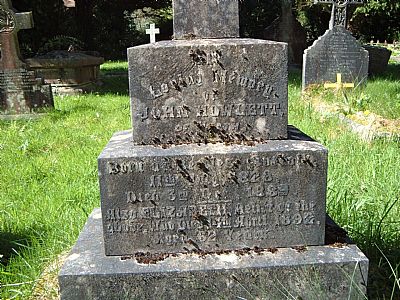
John Howlett’s grave at St. Matthew’s church, Dyffryn, Neath
The Cambrian newspaper reported his death thus:
‘In the person of Mr. Howlett, Superintendent of the County Police for the Swansea Division of Glamorgan, death has removed from our midst, with startling suddenness, another old and well-known and faithful public servant. So recently as on Saturday last he was present at the Swansea County Petty Sessions in pursuance of his duties. He was then hale and hearty, to all appearances, and did not complain, but it had been noticed for some time that he had developed an odd tendency to sudden somnolency even when in attendance in court. On Monday he drove from Morriston to Clydach through the cold east wind. The result was a sudden seizure of an apoplectic kind, coupled with paralysis and total loss of consciousness. Dr. Gabe was called in, and at 2 o'clock on Tuesday morning, Dr. Padley, our most experienced and respected Swansea physician, was roused out of bed. and went off at once to the sick man's bedside for consultation. But there the sufferer lay, a Hercules in physical stature, in fine condition of body, but wholly unconscious from effusion of blood upon brain and consequent total paralysis. Everything that medical and surgical still could suggest was tried, but without avail, and death supervened on Tuesday evening at 8 o'clock.
Superintendent Howlett had been a great many years in the County Force, and was generally respected as a genial man and vigilant officer. As Inspector of Weights and Measures he had enjoyed, it is said, considerable emoluments, which however had been lessened by recent Local Government changes and alteration of district. He had been for some time conscious of a dangerous tendency of his blood to rush to his head, and, no doubt, recent county changes did not contribute to such equanimity as such tendencies counsel on the parry of sufferers. These worries, coupled with the sudden and most severe alterations of climactic conditions in the first part of the week, were too much for his otherwise strong constitution.’
